Monday, 3 June 2013

Police Museum

We arrived at the Police Museum about 10 minutes before the advertised time and were lucky enough to score a park on the premises, we were the only public members to do so ;-).  A retired police officer dressed in an old police uniform met us at the gate swinging a bucket ready to collect our $5 entry fee. The Museum was manned by volunteers of the police force both current and retired as well as the members of the Police Historical Society.  They  were in fine form and only too willing to help and further explain the exhibits.

There was a good display of two and 4 wheeled vehicles was in the courtyard and we met a retired officer who had served with my father-in-law and he explained how the  radar units in police vehicles worked and proudly showed us his personal motor cycle which is the same as the current BMW bikes used by the Police. 

He also took us into the area that was out-of-bounds to the public.  It housed the workshops of the historic vehicles and also had the ones not on display, like the Black Maria and the first police boat.  We were very privileged.  One building housed an impressive 4 rooms of displays covering Forensic, Drug Squad, Communications, badges & head wear, country stations, old records and historical things. Each room had an officer or person available for questioning and I enjoyed meeting Mr Beare (uncertain of his rank) who had been an instigator of the drug squad (he started the drug squad) and he told us many interesting and amusing stories of his time on the force. The next building had some historical photos and tea, coffee and biscuits were available for $2 as well as a movie about the force whilst we were able to rest our sore feet.

The next section we explored was the Mounted Police Horses. Unfortunately there were not many horses to be seen but we saw the stables, exercise machine and yard with sand where the horses could roll about. The SA Police only use greys which could be because an earlier officer did not like the look of multi coloured horses and thought the police uniform looked better against the grey horse. We moved on to the Police Band building where we saw a film about the various band leaders and a clip of their performance at the prestigious Edinburgh Tattoo. At the end of the film everyone else filed out of the room leaving us to ask questions and be shown through the room where the instruments are stored and see the huge trunks which are used to transport the uniforms and instruments interstate and overseas.  We also saw a good photographic display of the band through the years. Our final stop was a police wagon with dog handler and we were able to pat the beautiful german shepherd. Again the handler told us stories about her dog and talked about the dog being retired when it turns 8 years old and about a year prior to that she will have to begin working with another dog. We spent over 3 hours at the Police Museum, it was the best $5 I have spent.

*                  

*                   

Royal Adelaide Hospital


This historical display was quite small considering the vast history the Royal Adelaide Hospital would have, It was up on the first floor in the foyer area, an unusual place and very noisy. There was an impressive range of nurses uniforms, medical instruments, information on Adelaide Lunatic Asylum, optical equipment and microscopes. It was quite awkward to photograph due to building lighting but well worth a visit. I would hope this exhibition is made available more often, or even better as a permanent display. Many of us have visited the RAH but had more pressing medical problems to think about the history, but this could be a welcome distraction.. It was also interesting walking through the buildings on the site, to see the wonderful workmanship in the Nurses Quarters to the ultra modern IMVS building. A quick but informative time spent here.


Clay Lineage – The London Pottery to the Jam Factory


I went to this exhibition not knowing what to expect. It was held in the St. Peters Town Hall, I had never been in this building before and what a magnificent building it is.


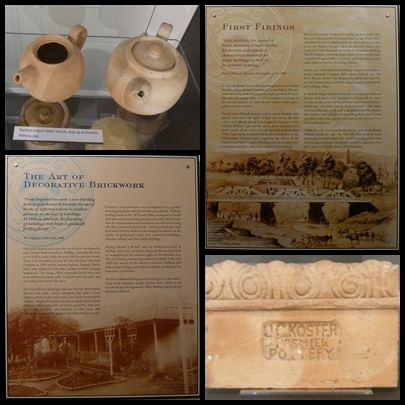
The exhibition celebrated the tradition of potters in Norwood, Payneham and St Peters. We saw examples of simple household items, pie funnel, vases and kitchen jars, to bricks, electrical insulators and terracotta garden edging. This exhibition is well mounted and displayed. There were explanatory mounted information boards and articles in glass cabinets and out in the open.


Saturday, 25 May 2013

St Aiden's Church

The Church today
St Aiden’s Church is on the corner of OG and Payneham Roads and I guess many of us have passed this Church with barely a sideways glance due to the busy traffic. When we arrived mid-morning a number of parishioners greeted us and plied us with information booklets. 


Beautiful Stained Glass Windows
There is a beautiful stained glass window at the back and another at the front of this lovely red brick church. 


Some of the needlework
There are obviously quite a few needleworkers as there is a wide range of tapestry kneelers in various sizes with religious and secular themes. I particularly liked the ones depicting Australian flowers e.g. Sturt Dessert Pea, and the musical ones. We met a lovely elderly gentleman who had made and designed at least 6 tapestry kneelers which he proudly pointed out to us. We were given a lovely cup of tea and offered scones, jam and cream but as we are very good girls we declined the scones!


Top left: Original Church - Top right: Church destroyed after storm - Bottom left: Church after re-build -  Bottom right: Church from OG road in the early 1900's

Latvian Museum


We chose to visit the Latvian Museum for no other reason but to fill in some time. We were greeted by some very nice people who asked if we needed our tour in Latvian or English. The museum is set up in a lovely old cottage in Wayville with three rooms of costumes, crafts and the history of the Latvian immigrants in SA. The costumes were delicately embellished with beads and exquisite stitchery in many styles, there were also shoes and jewellery and an impressive collection of amber.
Each region in Latvia had their own style of clothing/costume. The clothing was not behind glass so we were able to inspect the delicate work at close quarters and also take photographs. There were also reminders of their hurried departure from Europe and the attempts of the Australian Government to integrate them by teaching them to speak English. In the early days the Latvian people were targeted for migration often due to the fact that they looked similar to the Australian people (White Australia Policy).
I have a vested interest in Latvia, my great grand uncle ran his shipping business from Libau and Riga, he married a Latvian lady and had two children there. I have been researching his interesting life whist in Latvia, so it was nice to see what the people would have looked like in their dress style and also the home decorations that might have been in his house. We did not have time to visit the Latvian church which is opposite but this is another place to visit at a later date.